


Start with the evidence
A water-treatment decision starts before the product page. First establish the supply, any active instruction from the supplier or local authority, and the evidence that describes the water. Then define the problem, compare methods and account for the work that follows installation.
The Drinking Water Inspectorate publishes consumer information about drinking-water quality and directs people to the relevant organisation when a problem needs reporting.[1]
Primary route: Start with your water → /start-here/ Secondary route: Learn how to read a result → /water-testing/
Current briefing
What does this result actually describe?
A number is only useful when its frame travels with it: issuer, sample point, date, method, unit, reporting limit and jurisdiction. A supplier-area report, a home screen and a household sample analysed within an appropriate accredited scope do not answer the same question.
Read the Water Testing guide before using a result to justify treatment.
Where treatment happens is not what it removes
“Whole house” and “under sink” describe location. They do not establish the contaminant, capacity or performance of an exact product. DWI’s private-supply treatment guidance says treatment type and design depend on water properties and the contaminants present, including their concentrations.[5]
The replacement schedule belongs in the buying decision
A purchase price omits cartridges, media, lamps, salt, cleaning, service, water, energy and follow-up checks. DWI advises consumers to follow manufacturer cleaning, maintenance and cartridge-change instructions.[3]
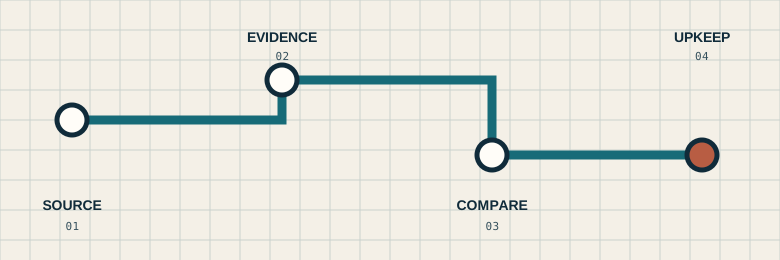
The decision path
01 / Assess
Identify whether the property uses mains water or a private supply. Check for an active boil-water, do-not-use or other official instruction. That instruction takes priority over general website guidance.
02 / Define
Separate four questions that are often mixed together: safety, taste/odour/colour, hardness and scale, and a problem arising in the building’s own plumbing.
03 / Compare
Compare methods only after writing down the result you need, the point of treatment, peak flow, pressure, space, drainage, power and evidence required for an exact performance claim.
04 / Maintain
List every replaceable part, service task, failure signal and verification step. A system that cannot be maintained is not a complete plan.
Choose a route
Assess
/start-here/: build the decision brief before comparing equipment./water-testing/: understand source, sample, units and evidence scope.
Treat
/whole-house-treatment/: point-of-entry systems and treatment stages./drinking-water-systems/: under-sink, countertop, gravity and RO choices./hard-water-softening/: hardness, softening and conditioning claims./uv-water-treatment/: UV’s role, validation inputs and maintenance.
Maintain
/taps-showers-leaks/: fixtures, scald considerations and leak-protection questions./costs-maintenance/: compare installed and five-year ownership cost.
How this publication works
Home Water Blueprint separates official guidance, accredited analysis, independent certification, manufacturer information, desk research and any future hands-on work. It does not describe a product as tested by the publication unless that work has happened and the method is documented.
The publication does not determine whether an individual water supply is safe. Official instructions, appropriately scoped testing and qualified advice take over when the question exceeds general education.