
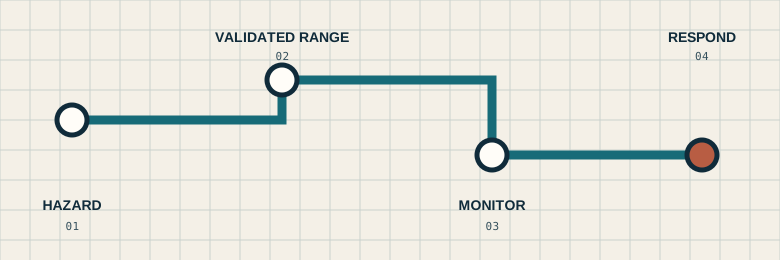
Safety boundary
If a boil-water notice, positive microbiological result, private-supply incident or illness is involved, follow the responsible authority and appropriate laboratory, medical or qualified professional advice. This page cannot confirm that water is safe or design a UV installation.
UV is one control, not a complete water system
DWI’s UV guidance concerns disinfection. It says a reactor must be selected and operated for identified hazards and site-specific water conditions, with validated performance.[6]
UV does not remove sediment, hardness, dissolved salts, metals or chemical contaminants. Any upstream or downstream stage must be justified by the analysis and the exact equipment requirements.
Evidence before equipment
For a private supply, start with the local-authority risk context and suitable analysis.[4] DWI’s treatment guidance says treatment selection depends on water properties and contaminant presence/concentration.[5]
A quotation should state:
- source and microbiological risk being controlled;
- analysis and sample context;
- peak flow through the reactor;
- the validated operating range;
- UV transmittance or absorbance basis where required;
- turbidity and other water-quality limits;
- upstream treatment needed to stay in range;
- alarm, shutdown and bypass behaviour;
- commissioning and verification plan.
Read validation precisely
“UV lamp,” “rated flow” and a wavelength statement are not enough. Ask who validated the exact reactor, which method was used, the dose/fluence and organism basis, the flow and water-quality range, lamp state, fouling assumptions and any sensor requirements.
DWI says reactors should not operate outside site-specific validated conditions unless another appropriate risk control is in place.[6]
Do not convert “tested to” or a component certificate into validation of the installed reactor for a household supply.
Monitoring and alarms
DWI’s public-supply guidance calls for monitoring and recording flow, lamp status, UV fluence rate, relevant absorbance/turbidity, maintenance and lamp replacement information.[6] A domestic/private installation must follow the exact applicable manufacturer and professional requirements; this page does not transplant a public-water operational programme into a household prescription.
The reader should still ask:
- What does the alarm measure?
- Does the system stop flow or only warn?
- What happens during power loss?
- Can untreated water pass through bypass?
- Who responds, and how quickly?
- When is an alternative supply required?
Fouling, pre-treatment and maintenance
Water quality can reduce UV delivery or foul the sleeve. The exact limits come from the validated system and source-water assessment, not a universal internet checklist.
Follow the manual for cleaning, lamp replacement, sleeve inspection, sensors and sanitisation. DWI’s treatment guide says manufacturer maintenance instructions are the minimum and advocates preventive maintenance.[5]
Failure plan
Document lamp or sleeve breakage, alarm, sensor failure, low dose, high flow, unsuitable water quality and loss of power. State who isolates the system, how users are informed, what alternative supply is available and what evidence is needed before normal use resumes.
Ownership cost
Include reactor, installation, pre-treatment, lamp, sleeve, sensor, electricity, service, sanitisation and verification testing. A cheap reactor without a maintainable monitoring and response plan is not a complete comparison.
Next steps
- Testing and private-supply context →
/water-testing/ - Wider treatment train →
/whole-house-treatment/ - Lamps, service and five-year cost →
/costs-maintenance/ - Full safety policy →
/about-disclosure/#safety