
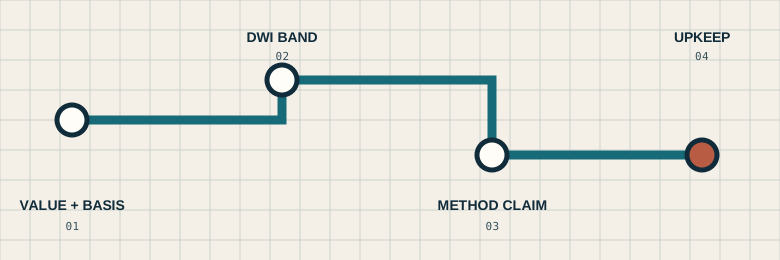
Start with a measured value
DWI explains that hardness is caused by dissolved calcium and magnesium and expresses its consumer classification in mg/L as CaCO₃.[2] Keep the basis with the number. A TDS reading is not a hardness measurement, and a postcode map is not a tap result.
DWI advises asking the water company for an accurate measurement because local variation may not appear on a general map.[2]
What hardness can explain
Hardness can help explain scale on heated surfaces and differences in lather. It does not identify unrelated contaminants and it does not determine whether an individual supply is safe.
DWI notes that UK drinking-water regulations do not set standards for hardness, calcium or magnesium.[2] Do not turn a DWI consumer classification band into a health threshold.
Read units before converting
A production hardness tool should first ask for the exact unit and basis shown on the source. The launch page may classify a value already supplied as mg/L as CaCO₃ using DWI’s bands. Cross-unit conversion remains gated until each constant and rounding rule has an authoritative source.
Never silently treat:
- general
ppmas hardness expressed as calcium carbonate; - conductivity or TDS as hardness;
- grains per gallon without stating that the gallon is US;
- a supplier’s broad area value as a household measurement.
Softening and conditioning are different claims
DWI describes domestic ion exchange as replacing calcium and magnesium ions with sodium ions.[2] It also distinguishes devices that claim to alter scale behaviour from equipment that softens the water.[2]
For any product, record whether the claim is:
- measured hardness reduction;
- ion exchange capacity;
- scale-control or conditioning;
- a manufacturer observation;
- an independent test or certification;
- unknown.
Do not call a conditioner a softener unless evidence shows measured hardness reduction.
Sizing inputs
A fair softener brief needs:
- measured hardness and unit;
- metered household use where available;
- peak flow;
- the capacity convention used by the manufacturer;
- regeneration assumptions;
- salt and water use;
- drain, overflow, bypass, power and access;
- drinking-water arrangement;
- unusual chemistry or private-supply flags.
The page does not provide a sizing answer. Final selection and installation need exact manufacturer information and appropriately qualified advice.
Drinking-water and installation boundary
DWI advises retaining an unsoftened kitchen supply for drinking and cooking when base-exchange softening is installed.[2][3] This wording must remain UK-specific and must be checked again during final production review.
Use a qualified installer and confirm the applicable water-fittings requirements. Do not convert a trade logo or generic approval statement into contaminant-removal evidence.
Maintenance and cost
Record salt, cleaning, sanitisation, service, water used during regeneration and replacement components. DWI advises following the manufacturer’s maintenance instructions and considers ongoing service important for domestic softeners.[2][3]
Next steps
- Find the correct result →
/water-testing/ - Place softening in a wider system →
/whole-house-treatment/ - Keep drinking-water treatment separate →
/drinking-water-systems/ - Compare five-year cost →
/costs-maintenance/