
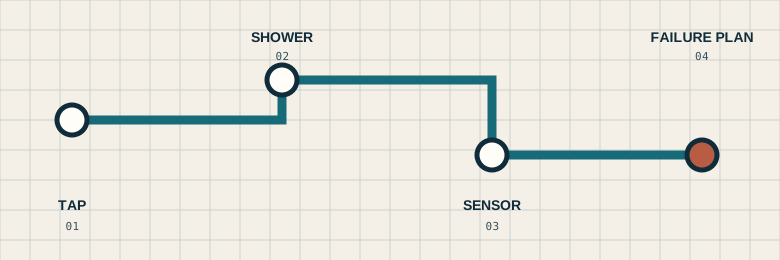
A filtered or boiling tap, a shower filter and a leak-protection system should not share one promise. They address different outlets and risks. Compare each against its own job.
Filtered and boiling taps
Write down the functions actually included: filtered ambient, boiling, chilled, sparkling or a combination. Then check:
- exact tap and treatment model;
- cartridge identity and evidence;
- tank or boiler space;
- pressure and flow requirements;
- electricity, ventilation and drainage;
- scald controls and child access;
- isolation, service access and warranty conditions;
- cartridge, energy and service cost.
DWI advises domestic-treatment buyers to check the product, installer and applicable water-fittings position, and to follow manufacturer cleaning and replacement instructions.[3]
A boiling-water function introduces a scald hazard. NHS describes scalds as injuries caused by hot liquids or steam.[10] Product copy must describe the exact documented controls without promising that an appliance is “scald-proof.”
Shower filtration
Start with the exact parameter a product claims to reduce. Record the model, test or certification basis, water temperature, flow, capacity and cartridge condition.
Do not promise improvements to eczema, hair, skin, breathing or another medical outcome. A review may report what the manufacturer claims, but it must separate that from independent evidence and medical advice.
Do not treat scale, chlorine-related claims and hardness as interchangeable. A cartridge that makes one reduction claim has not thereby proved hardness removal.
Leak sensors
A local audible sensor, a connected sensor and a valve-based shut-off answer different questions. Compare:
- water-contact or flow-detection method;
- placement and coverage;
- local alarm and remote notification;
- battery, mains and connectivity dependence;
- notification delay and failure mode;
- valve/pipe compatibility;
- manual override;
- installation and routine testing;
- subscription or service dependency.
A sensor or valve may reduce exposure to a leak event, but it cannot guarantee that every leak or loss is prevented. Production comparisons need exact model evidence rather than a generic smart-home claim.
Build a failure table
For each product, record what happens if:
- the cartridge is exhausted;
- power or broadband fails;
- a notification is missed;
- a valve sticks or is bypassed;
- an alarm is silenced;
- the property is unoccupied;
- replacement parts are unavailable.
This table often reveals more than feature counts.
Keep the costs separate
A high purchase price may include installation or service; a low one may omit adapters, cartridges, valves or subscriptions. Compare the installed first-year cost and a five-year maintenance scenario using the same scope.
Next steps
- Treatment claim evidence →
/water-testing/ - Drinking-water filter formats →
/drinking-water-systems/ - Hardness versus shower claims →
/hard-water-softening/ - Ownership-cost framework →
/costs-maintenance/