
Start with the treatment objective
“Whole house” tells you where equipment sits. It does not tell you what the equipment treats. DWI’s private-supply guidance says treatment type and design depend on the properties of the water and the contaminants present, including their concentrations.[5]
This guide organises a comparison. It does not design a treatment train for a property.
Point of entry and point of use
Point-of-entry equipment treats water near the incoming supply. Point-of-use equipment serves a particular outlet. A household may have different objectives at those points. Treating all incoming water is not automatically more complete, and a drinking-water unit is not automatically suitable for whole-house demand.
Think in stages
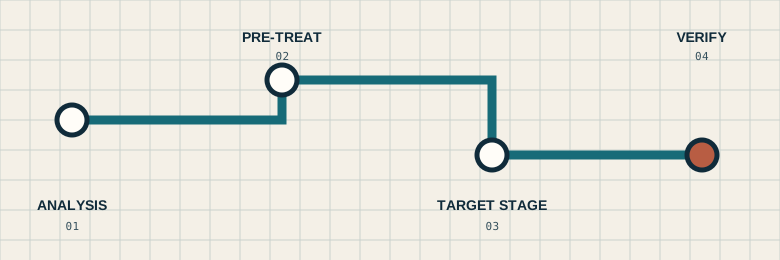
A treatment train may contain pre-treatment, a process aimed at a measured parameter, disinfection where justified, and final conditioning or point-of-use treatment. DWI describes the multi-barrier approach as a series in which each process can prepare water for a downstream stage.[5]
A diagram on this page must remain generic. It may show dependencies, bypass and sample points. It must not imply that sediment → carbon → softener → UV is a universal sequence.
Write the design inputs
Ask a supplier or designer to work from:
- supply type and full relevant analysis;
- target parameter and required outcome;
- peak simultaneous flow, not average daily use alone;
- dynamic pressure and allowable pressure loss;
- space, drainage, power, frost and access;
- bypass, isolation and sampling points;
- consumables, service intervals and failure response;
- how performance will be commissioned and checked.
For a private supply, the risk assessment and water analysis come before equipment selection.[4][5]
Read a treatment claim precisely
A technology category is not a product result. Record the exact model, parameter, claim type, test or certification basis, flow, capacity, influent conditions and maintenance state.
Regulation 31 is often misunderstood in consumer marketing. DWI’s own decision page says products used within a property boundary do not require approval under Regulation 31.[7] Do not present Reg 31 as household contaminant-removal certification.
Plan failure as well as normal operation
Ask what the household sees when:
- pressure drops;
- media or a cartridge is exhausted;
- a valve fails;
- power is lost;
- an alarm is ignored;
- bypass is opened;
- maintenance introduces contamination.
The answer may be an alarm, shut-off, alternative supply, service response or verification test. It must be documented for the actual system.
Maintenance is part of treatment
DWI’s treatment guide says maintenance should be preventive rather than only responding after failure, and that manufacturer instructions are the minimum requirement.[5]
Record inspections, cleaning, consumables, service and sample results. Price those tasks before comparing quotations.
Questions for a quotation
- Which measured parameter does each stage address?
- What does each stage leave unchanged?
- What evidence supports the exact model and flow?
- What protects the next stage?
- What causes bypass, alarm or shutdown?
- Which parts are replaced, by whom and at what trigger?
- How will the installed result be checked?
Next steps
- Evidence and sampling →
/water-testing/ - Drinking-water outlet →
/drinking-water-systems/ - Hardness stage →
/hard-water-softening/ - UV stage →
/uv-water-treatment/ - Five-year cost →
/costs-maintenance/