
What this guide can and cannot answer
It can explain the information that gives a result its scope. It cannot decide whether an individual supply is safe, diagnose a contaminant from taste or appearance, or replace interpretation by the responsible authority or laboratory.
DWI provides consumer guidance on drinking-water quality and routes for reporting a problem.[1]
Three evidence scopes
Supplier information
A water-company report describes the company’s monitored supply context and reporting period. It is the right place to begin for mains water, but it may not answer a question created by a property’s service pipe, storage or internal plumbing.
Home screening
A strip, colour comparison or electronic meter answers only the measurement it was designed to make, within its stated range and conditions. It is not a substitute for a broad contaminant panel or method-controlled laboratory analysis.
Household or private-supply analysis
For a consequential decision, check the laboratory and the method. UKAS’s directory lets users search accredited organisations.[9] Confirm that the relevant activity appears in the current scope rather than treating the word “accredited” as universal coverage.
Private supplies have a separate regulatory and risk-assessment context. DWI’s owner/user guidance says private supplies are subject to regulations and local-authority monitoring.[4]
The report frame
Keep these fields with every result:
- issuer;
- supply and sample point;
- collection date and operating conditions;
- method;
- unit and chemical basis;
- reporting or detection limit;
- qualifier, uncertainty or accreditation scope;
- applicable jurisdictional comparison;
- whether the figure is one result, a range or an average.
“Not detected” means the method did not report the parameter above its stated limit. It does not prove absolute absence.
Sample point changes the question
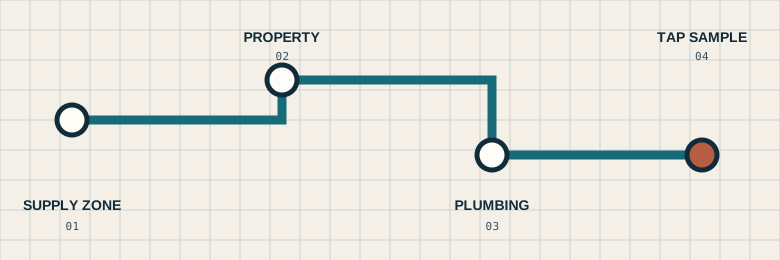
A result at the treatment inlet, a result after a storage tank and a first-draw result at a tap do not represent the same water or the same exposure window.
Lead is a clear example of why property context matters. DWI says a householder who suspects lead pipes can ask the water company to test water at the kitchen tap.[8] DWI also explains that standing time and pipework can affect lead at a property.[8]
Do not generalise that example into a universal sampling protocol. Follow the water company or laboratory instructions for the actual question.
Units need their basis
Keep the original unit. mg/L, µg/L, mmol/L, conductivity and hardness expressed as calcium carbonate are not interchangeable labels. A TDS or conductivity figure does not identify which dissolved substances are present and cannot certify purity or safety.
Build a treatment brief from evidence
A useful brief states:
- the parameter and result;
- sample point and date;
- method, unit and reporting limit;
- target outcome;
- required flow and location;
- existing plumbing/treatment;
- uncertainty that still needs resolving.
Then compare a treatment method’s exact claim and operating conditions. Do not choose a system for an unmeasured contaminant merely because its marketing lists many stages.
When to use a higher-assurance route
Use the responsible authority and appropriately scoped laboratory/professional route for private supplies, microbiology, lead or another serious contaminant, conflicting screens, unclear units, commissioning or verification of consequential treatment, or a concern involving a vulnerable person.
Next steps
- Build the initial brief →
/start-here/ - Point-of-entry treatment →
/whole-house-treatment/ - Drinking-water systems →
/drinking-water-systems/ - Hardness result →
/hard-water-softening/ - UV context →
/uv-water-treatment/